

Your website got cited by AI.
Congratulations. Someone else’s product answered your customer’s question using your work, and put a small link beside it.
Did they click? Did they remember your name? Did they buy anything?
Those feel like reasonable follow-up questions.
The industry has already named the first part generative engine optimization, or GEO. We have agencies, software subscriptions, and dashboards for it. The second part still requires explaining where the money went.
I build websites and help businesses use AI. I think getting found in AI search matters. I also think we’re dangerously close to selling each other screenshots of a chatbot saying our names.
So here’s what I’d actually work on. And what I’d want measured before calling it a win.
Being Mentioned, Cited And Recommended Are Three Different Things
Imagine you run a roofing company.
An AI answer names your business while explaining which companies operate locally. That’s a mention.
It links to your article about what hail damage looks like. That’s a citation.
It tells someone you’re a good choice to inspect their roof. That’s a recommendation.
All three might help. They don’t mean the same thing.
You could get cited because you published an excellent explanation, while the answer recommends somebody else to do the job. You could get mentioned in a complaint. You could be recommended using information from another website, without your own site getting a link at all.
A dashboard that rolls these into one rising number is leaving out the part you actually needed to know.
Ask what the answer says about you, not just whether you’re in it.
The Click Problem Is Real. The Replacement Isn’t Automatic.

Ahrefs studied 300,000 keywords and estimated that, in December 2025, an AI Overview was associated with a 58% lower click-through rate for the first organic result than its forecast without one.
That’s a desktop estimate from an observational study. It doesn’t mean your website lost 58% of its traffic, and it doesn’t tell us what a ChatGPT citation converts at.
It does give the anxiety something more substantial than a LinkedIn post.
If the answer appears before the click, some people have less reason to click. Getting cited inside that answer might help you. It doesn’t automatically replace what you lost underneath it.
The reader who only wanted a definition may be finished. The reader comparing contractors may still need a quote, proof of your work, and someone who answers the phone.
Those are very different opportunities. I’d build around the second one.
Google Has Not Asked You To Buy A New Kind Of SEO
Google’s documentation says there are no extra requirements or special optimizations needed for AI Overviews or AI Mode. Your page needs to be indexed and eligible to appear with a snippet.
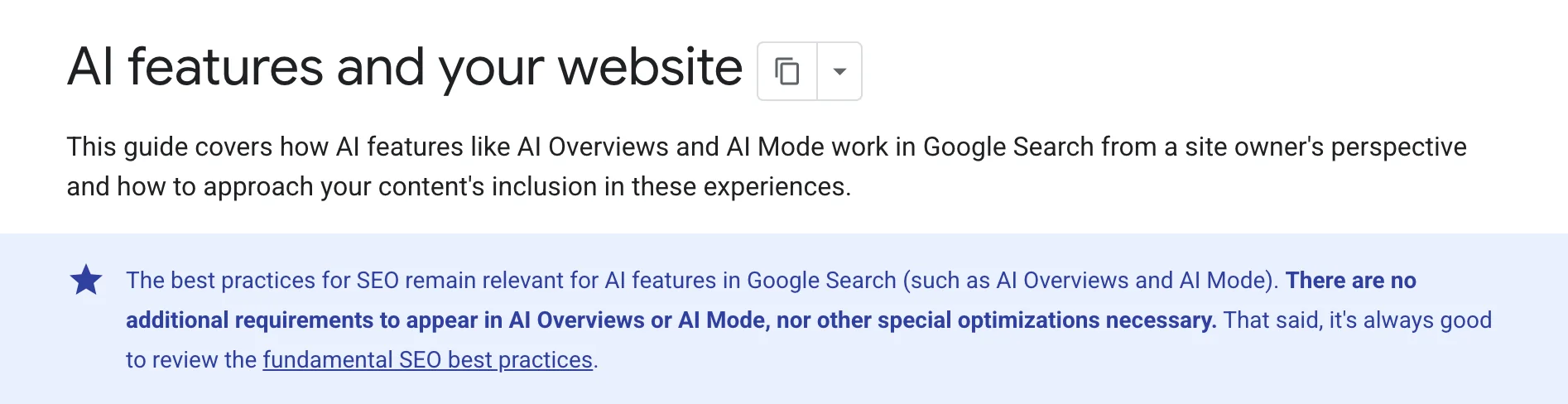
https://developers.google.com/search/docs/appearance/ai-features
It also says you don’t need special AI files or a new kind of structured data.
That is an awkward paragraph to put beside some of the proposals being sent around.
It doesn’t mean there’s no work to do. It means the work needs to survive a more specific question than “are we GEO-ready?”
Can the crawler access the page? Is the important information available as text? Do internal links lead to it? Does the structured data agree with what a visitor can actually read?
Google lists those things. None requires inventing a new acronym.
Google’s guidance also isn’t a specification for every other search product. Anyone promising one universal recipe owes you evidence from the systems they’re selling it for.
Let The Search Crawler In. Know Which One That Is.
There is a practical distinction worth understanding here.
OpenAI separates its crawlers. OAI-SearchBot supports discovery in ChatGPT search. GPTBot collects material that may be used to train its foundation models. Their controls are independent.
You can allow the search crawler while disallowing the training crawler.
So “we block AI” isn’t enough information to diagnose anything. Which bot? In your robots.txt file, or at the firewall? Is your hosting provider serving it a challenge page instead of your article?
OpenAI recommends allowing OAI-SearchBot and its published IP ranges for search visibility. That’s an access requirement, not a promise that the next answer will choose you.
Get whoever manages the site to check the actual response. A perfectly worded page behind a blocked request is still a blocked request.
Give The Answer Something It Couldn’t Get From Everyone Else
This is where the useful work starts.
If your page says AI receptionists answer calls around the clock, congratulations again. You have described the product category.
I’d rather read which calls yours hands to a human, what happens when it gets a name wrong, and what a real month costs after the included minutes run out.
Those details help a buyer make a decision. They’re also something another explanation can refer to.
Publish the comparison you actually made. Show the calculation and its assumptions. Explain the exception that changed your recommendation. If you ran a test, describe how you ran it and where it failed.
Then make the useful part easy to find. Put the answer near the question. Give the table proper labels. Link a number to the study it came from. Keep the qualification beside the claim, so someone extracting the paragraph doesn’t leave with half the truth.
I’m recommending an editorial standard here, not claiming to know a secret citation factor.
It’s the same conclusion I reached in the post about Google’s AI-content policies: a page needs a reason to exist beyond the fact that you could generate it.
Making that page readable by a machine is useful. Having something worth reading comes first.
A Citation Can Be Worth Something Without Being Worth The Invoice

I don’t think every mention needs to produce an immediate sale. People can discover you in an answer, remember you, and come back later. Attribution has never been tidy.
But “brand awareness” cannot become the emergency exit every time someone asks whether the work helped.
Here’s a hypothetical. Your visibility report goes from ten citations to a hundred. Most are attached to a definition that the answer explains completely. Nobody needs your site to finish the task.
Another page gets cited twice, in answers about choosing a consultant. One reader visits, checks your work, and books a call.
Which page gets the next afternoon of your time?
I’d want reporting that keeps citations, visits, qualified enquiries, and revenue separate. I’d also ask new clients how they found me. That won’t reconstruct every journey, but it gives you another piece of evidence when the analytics stop short.
The point isn’t to pretend everything is measurable. It’s to keep the uncertainty visible instead of painting it green.
Start With Ten Questions Your Customers Actually Ask
Before buying a monitoring subscription, I’d run a small baseline.
Choose ten questions from sales calls, emails, or your existing search data. Include the awkward ones: cost, alternatives, who the service isn’t right for, and what can go wrong.
“Best company ever” with your brand pasted into the prompt does not count.
Run those questions in the search products your customers use. Start fresh conversations, keep the wording, and repeat each question a few times. Record the date, product, search mode, linked sources, and what the answer actually said about each business.
Keep the answers where you didn’t appear.
This is a sample of behaviour under those conditions, not your permanent position in an invisible league table. A small repeated check can reveal questions worth investigating; it cannot establish a universal ranking rule.
Look at the pages being cited. What do they contribute? A price? A firsthand comparison? Evidence from outside the company’s own marketing?
Use that to find something your site genuinely needs. Improve a few relevant pages, repeat the check later, and watch what visitors do when they arrive.
Don’t change twenty things, get one favourable answer, and announce that you’ve cracked it.
I Would Still Build A Website Worth Visiting
There’s a strange version of this strategy where you spend all your effort making your website easier to summarize, then act surprised when nobody needs to visit it.
Give people the answer. Also give them a reason to choose you after they’ve read it.
Show the work. Explain your judgement. Make it clear what you do, who you help, and how to take the next step. A service business needs that whether the introduction comes from Google, an AI answer, or someone’s neighbour.
That’s the work I’d pay for. Crawl access, useful evidence, clear pages, and reporting that follows the reader far enough to tell you something.
Being a source is good. Being the business someone chooses is what pays for it.
If you’re figuring out what to change on your website or where AI fits in your business, that’s the work I do. Start with the problem you need solved. We can name the acronym afterwards.
Keep reading
Related posts
Three more worth reading, if this one landed

Does Google Penalize AI Content?
AI writes half of everything published and seven per cent of what ranks first. Google penalizes none of it. Search Console doesn't even have a category for it. That's the problem, not the reassurance.

The AI Model Tier List, October 2026
The best model on this list got cheaper when it got better, and last month's number one fell to C. Nineteen AI models ranked on what they are actually worth, with the blended price and an independent score on every row so you can argue with the placement.

AI Watermarks Are Here. The Danger Is They're Not That Good.
Since August 2, 2026, Claude marks everything it writes. Most of the worry is about being caught. The real problem is that the mark cannot prove what people are about to use it to prove.