

AI now writes about half of everything published on the web, but only seven per cent of what ranks first.
That isn’t a contradiction. It just isn’t a penalty.
What Google Actually Said, In Order
Google’s position changed quickly. In April 2022, it treated automatically generated content as spam. By February 2023, it was saying the method didn’t matter; the quality did.
That shift is the key to the whole question. Google stopped judging content by whether a machine helped produce it and started judging what the content was for, what value it added, and whether it was being produced at scale to manipulate search results.
-
John Mueller, Google Search
Chase’s noteGoogle treated AI-generated text as spam based on how it was made. In practice, that wasn't actually true. That position went unchallenged for seven months.
These [pieces of AI-generated content] would essentially still fall into the category of automatically generated content, which is something we've had in the Webmaster Guidelines since almost the beginning.
-
Danny Sullivan, Google Search Liaison
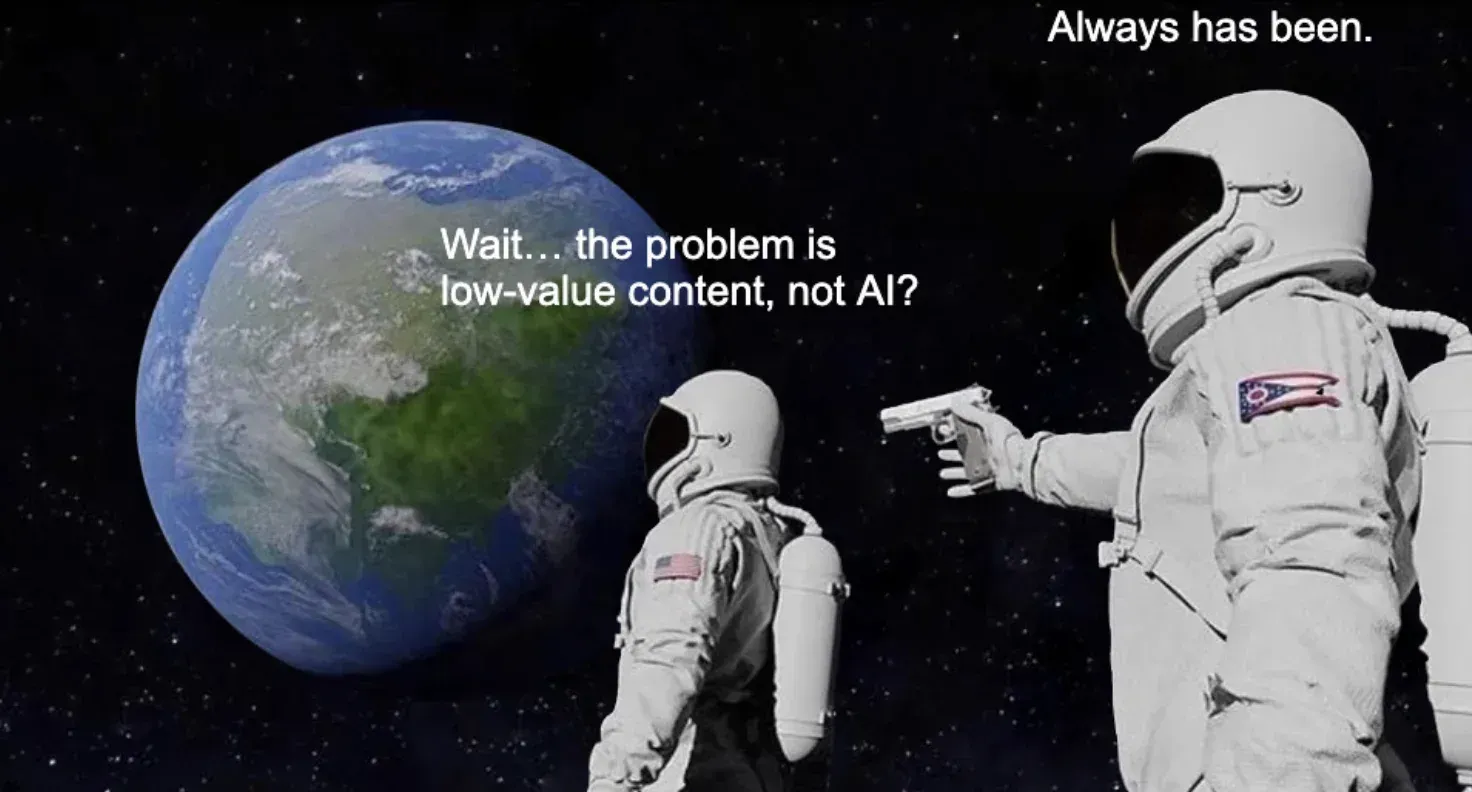
Chase’s noteThis was the first clear shift, three months before Google formalized it. AI was no longer the issue. The issue was content created for rankings rather than people. (see astronaut meme above)
Source: Danny Sullivan on X
-
Google Search Quality team
Chase’s noteThe reversal becomes official policy, in a post titled "Rewarding high-quality content, however it is produced." The first answer below is the sentence every "no penalty" article is built on. The second, further down the same FAQ, is the half that gets quoted less: using AI buys you nothing.


Source: Google Search Central
-
Chris Nelson, Google Search Quality team
Chase’s note"Spammy automatically-generated content" is deleted and replaced by "scaled content abuse." Read the quote again: Google is saying it often can't tell how a page was made, so it stopped needing to know.

Source: Google Search Central
-
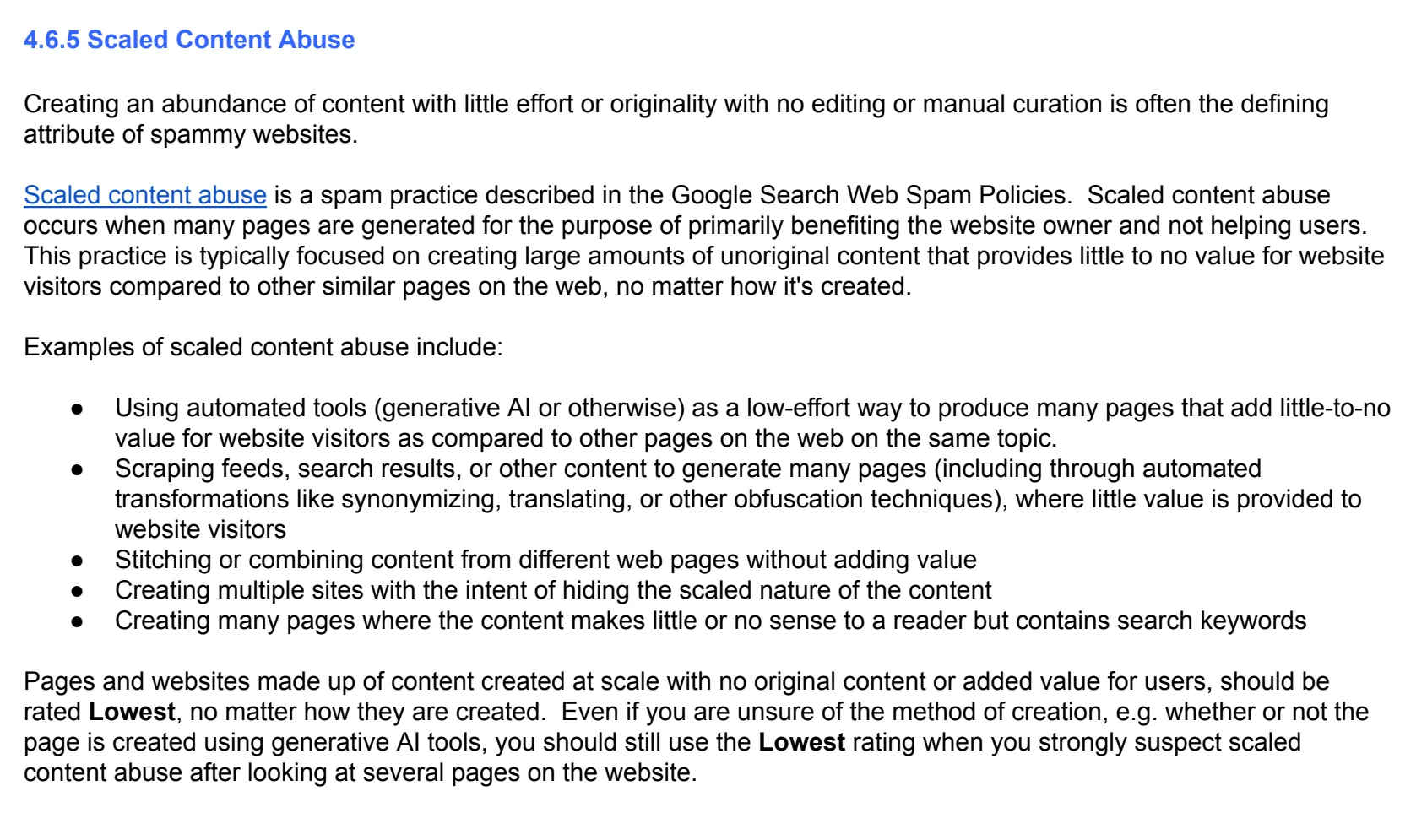
Search Quality Rater Guidelines, §4.6.5
Chase’s noteThe instruction Google gives its own human raters. Lowest rating, on suspicion, without establishing how anything was written.
-
John Mueller, Google Search Relations
Chase’s noteThe current bar, and it is the strictest thing Google has ever written on this. Not "don't use AI." Don't publish anything an AI could have produced.

An “AI Penalty” Isn’t Something Google Has

Open Search Console and look at the manual actions report. There are sixteen things Google can flag you for.
“AI content” is not one of them. Neither is “scaled content abuse.”
| Manual action | What it actually targets | Mentions AI |
|---|---|---|
| Back button hijacking | Breaking the browser's back button | No |
| Site abused with third-party spam | Spam someone else left in your subfolders | No |
| User-generated spam | Spam your own visitors submitted | No |
| Spammy free host | A hosting service mostly full of spam | No |
| Structured data issue | Markup describing content users can't see | No |
| Unnatural links to your site | Backlinks you bought | No |
| Unnatural links from your site | Backlinks you sold | No |
| Thin content with little or no added value | Scraped, doorway and thin affiliate pages | No |
| Cloaking and/or sneaky redirects | Showing Google something other than the page | No |
| Major spam problems | "Aggressive spam techniques such as scaled content abuse" | No |
| Cloaked images | Images that differ from the ones indexed | No |
| Hidden text and/or keyword stuffing | Text written for crawlers, hidden from readers | No |
| AMP content mismatch | An AMP page that differs from its canonical | No |
| Sneaky mobile redirects | Phones sent where the crawler isn't | No |
| News and Discover policy violations | Content policy, News and Discover only | No |
| Site reputation policy | Renting your domain to someone else's pages | No |
- Where mass-produced AI pages actually land
Source: https://support.google.com/webmasters/answer/9044175, retrieved September 2026.
Sites taken down for mass-producing AI articles get labelled Major spam problems or Thin content with little or no added value, categories that are older than generative AI and were written for people with article spinners.
That takes about thirty seconds to verify, and it is the single most useful thing you can know about this question. The thing you are afraid of is not a category Google possesses.
Which leaves the distinction that the rest of this post turns on.
A manual action is a penalty. A human at Google looked at your site, decided it broke a rule, and you get a message about it.
A core update demotion is not a penalty. Nothing looked at you, nothing decided anything about you, and you get no message at all. Your traffic is simply lower on Thursday than it was on Wednesday.
Almost everybody searching this question is worried about the first thing and exposed to the second.
50% Of Everything Published, 7% Of What Ranks
Graphite ran the two halves separately: one study sampled Common Crawl to measure what gets published, and a second sampled the results pages to measure what ranks. Sampling the crawl rather than the rankings sounds like a technicality and is actually the whole ball game. Every other study in this field samples pages that currently rank, and you can’t measure whether something gets removed by surveying the things that weren’t removed.
The web, and then GoogleSame detector, same corpus, three different populations
Graphite, October 2025. The publishing study sampled roughly 43,000 English articles from Common Crawl; the search study covered 31,493 keywords across the first two results pages. It is the only study in this field that published a validated false-positive rate of 4.2%, measured against articles written in 2020–2022, before ChatGPT existed. It excludes AI-assisted content that a human then edited, which the authors note is probably the largest category of all.
Half of what gets written. A seventh of what gets found. A fourteenth of what wins.
Something is removing AI content from search at enormous scale, and there is no penalty anywhere in the system doing it.
Ahrefs Published The Gap And Titled It “No Punishment”
The studies everyone cites aren’t lying. They are answering a narrower question than the one you asked, and the headline does the rest.
| Study | How it's quoted | What it measured |
|---|---|---|
| Ahrefs, 2025 600,000 pages | "Zero correlation between AI content and rankings" | Among pages already ranking in the top 20, a detector score doesn't predict which position they hold. Every demoted page is missing from the sample by construction. |
| Ahrefs, 2026 ~150,000 pages | "Google doesn't punish AI content" | Heavily-AI pages get indexed 40.35% of the time against 49.28% for low-AI pages, and take two to three times fewer impressions. That gap is in the article, under that title. |
| Semrush, 2026 42,000 posts | "Human content is 8× more likely to rank #1" | That GPTZero, which once scored the US Constitution as 92% AI, labels most #1 results "human." Nothing controls for the fact that the sites that can afford human writers also have the links. |
Sources retrieved September 2026. The most revealing line in Ahrefs' study isn't the headline but the caveat: AI detectors are statistical models that estimate probabilities, not certainties—and false positives are an unavoidable risk.
I don’t think Ahrefs is being dishonest. I think they mean a specific thing by “punish”: a manual action, a flag, a message in Search Console. By that definition they are completely right.
The reader searching this question means something else by it. They mean “will this cost me traffic.” And the same article says yes, by nine points of indexation and a factor of three in impressions.
The Studies Are Measuring A Detector, Not Your Writing

The more basic problem is the detector itself.
OpenAI launched its own AI text classifier in January 2023. It lasted six months. The company pulled it for its “low rate of accuracy”, despite having access to the models, the training data and the way the text was generated. OpenAI couldn’t reliably spot its own output.
The commercial detectors are trying to do the same thing with less information. In peer-reviewed testing of fourteen of them, the tools were “neither accurate nor reliable.” A little editing was enough to throw them off. Stanford researchers found another problem: they “consistently misclassify non-native English writing samples as AI-generated.”
Those mistakes aren’t evenly distributed. Detectors are suspicious of low perplexity: plain words, predictable sentences, familiar structure.
In other words, competent professional writing. The prose most likely to rank is also the prose the detector is primed to mistrust.
Now take the most repeated number in this debate: 100% of the sites deindexed in Google’s March 2024 update showed signs of AI content.
It sounds conclusive until you ask what the detector finds on sites that weren’t deindexed. The study had no control group. Ahrefs estimates that about 74% of new web pages contain detectable AI content. Test roughly 200 pages on each site against a base rate that high and you would struggle not to find at least one hit.
That 100% figure is what you would expect even if AI had nothing to do with the deindexing.
Nobody Tells You, And Most People Don’t Come Back
This is the part the reassuring articles leave out, and it’s the part that should actually govern your decisions.
Glenn Gabe tracked around 400 sites flattened by the September 2023 helpful content update. Eleven months later, 22% had recovered as much as a fifth of what they lost.
Not recovered. Recovered a fifth. Roughly one site in five.
The “you’d know because Search Console would tell you” reassurance has a hole in it too. Gabe documented a 20,000-URL site that was fully deindexed roughly a day before the notice showed up. And a core update demotion never generates a notice at all, because there is nothing to notify you about.
Danny Sullivan was asked directly whether sites get back to where they were. His answer is the truest sentence anyone at Google has said about this:
You can’t predict that every site will recover to exactly where they were in September because September doesn’t exist anymore.
Use My Content Pipeline Auditor
None of the above is an argument against using AI. It’s an argument about what the exposure actually is, and the exposure is a pipeline property rather than a writing-tool property.
Google does tell you what to do about it. Here is the whole of it, from the closing section of the same February 2023 post, signed by the two people whose names bracket this entire timeline:
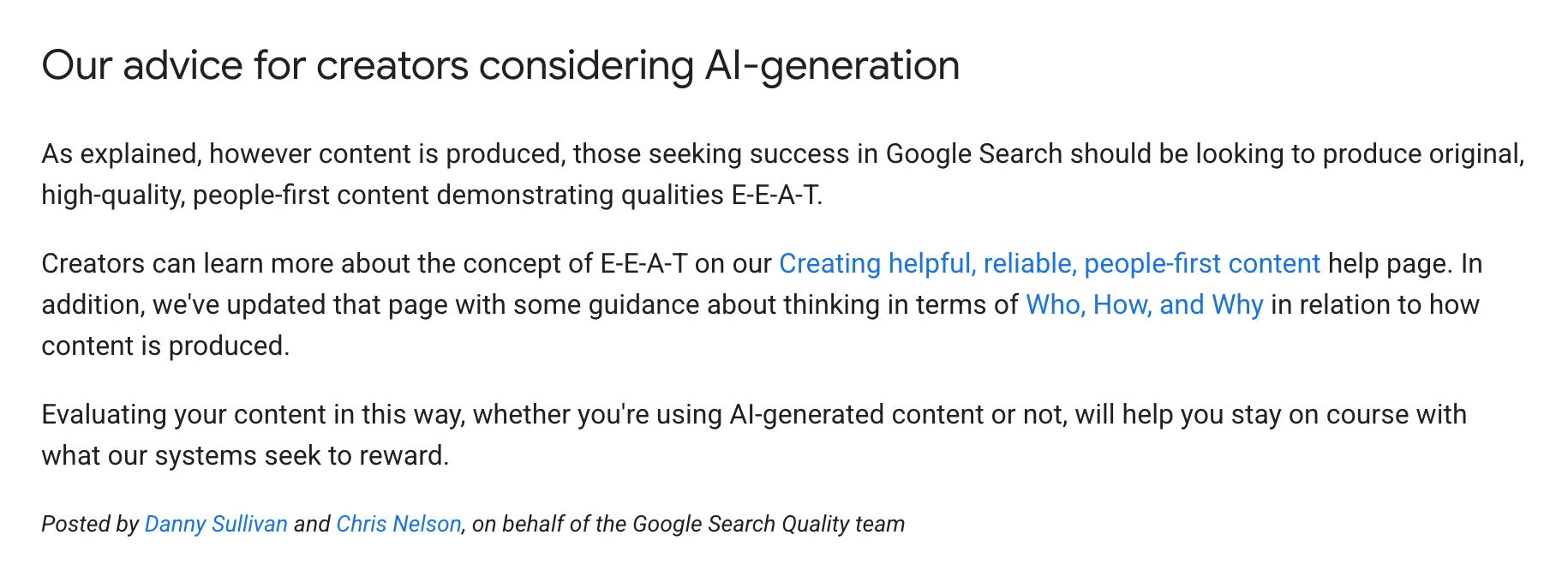
Source: https://developers.google.com/search/blog/2023/02/google-search-and-ai-content, retrieved September 2026.
Be original. Be helpful. Ask who, how and why. Fine. But none of that gives you a test you can run. You can satisfy every word on paper and still publish the exact pages Google demotes. These six questions do.
Pipeline score
Tick what's true of your own site.
Notice that none of the six mentions AI. That isn’t a rhetorical trick. Google’s actual policy doesn’t mention it either, except as one example among several of how you might produce content at scale.
The Thing That Will Actually Cost You

On August 30, 2026, Google stopped applying its site reputation demotions to users in the EEA after pressure from the European Commission. Its own policy page now says the consequences “vary depending on the location of users.”
The same page. Actioned for a reader in Ohio, untouched for a reader in Ireland.
Whatever a penalty is, it is a policy choice that a regulator can reverse, not a law of physics, and not a stable thing to build a content strategy against. Which is why “will I be penalized?” was always the wrong question. It asks about Google’s intentions when what you needed to know was the mechanism.
And the mechanism turns out not to need an opinion about AI at all. Google never built an AI detector. It built a proxy for what unedited AI output looks like: unoriginal, commodity, produced at volume, adding nothing that wasn’t already on the web. That proxy catches the same pages without ever having to know how they were made.
So no, nobody is going to penalize you for using AI. There is no flag, no message, no category, and nothing to appeal.
You will just be quietly outranked by someone whose page contains something a model could not have known.
Write that thing. The rest of it was never the risk.
The Questions Underneath This One
Can Google detect AI-generated content?
It doesn’t try. Google has never shipped an AI detector, and its own March 2024 policy says it often can’t tell whether a low-quality page was produced by automation. What it built instead is a proxy for what unedited AI output looks like: unoriginal, commodity, produced at volume. That catches the same pages without ever having to know how they were made.
Is AI-generated content against Google’s guidelines?
No. Google’s position since February 2023 is that appropriate use of AI or automation is not against its guidelines. The line it draws is purpose, not method: content generated primarily to manipulate search rankings is spam, whether a model wrote it or a person did.
Do I have to disclose that a page was written with AI?
There is no requirement, no markup for it, and no ranking effect either way. Google’s guidance only encourages disclosure where a reader would reasonably want to know how something was made. Disclose it because it’s true, not because you think it buys you something. It doesn’t.
Will AI content rank on Google?
It already does. About seven per cent of pages ranking first read as AI-generated, against roughly half of everything published, so it ranks at about a seventh the rate it gets written. Using AI earns no advantage of its own. Google’s own phrasing is that it’s just content.
Will Search Console tell me if I’ve been penalized?
Only for a manual action, and not always in time. One 20,000-URL site was fully deindexed roughly a day before the notice appeared. A core update demotion generates no notice at all, because nothing was decided about you.
If you’re working out what any of this means for how your business uses AI, that’s what I do. You might also want the piece on why AI watermarks can’t prove what people want them to prove, which is the same argument applied to authorship instead of rankings, or the guide to the tools worth using.
Every claim here was verified against the primary source in September 2026: Google’s own blog posts, spam policies and rater guidelines, the studies as published by Ahrefs, Semrush, Graphite and Originality.ai, and the peer-reviewed detection research. The one exception is flagged in the timeline. This moves fast. Check before you rely on it.
Keep reading
Related posts
Three more worth reading, if this one landed

How to Get Cited by AI Search. And What a Citation Is Actually Worth.
An AI can cite your website, answer your customer's entire question, and send you absolutely nobody. Getting into the answer matters. What happens after that is the part your dashboard needs to explain.

The AI Model Tier List, October 2026
The best model on this list got cheaper when it got better, and last month's number one fell to C. Nineteen AI models ranked on what they are actually worth, with the blended price and an independent score on every row so you can argue with the placement.

AI Watermarks Are Here. The Danger Is They're Not That Good.
Since August 2, 2026, Claude marks everything it writes. Most of the worry is about being caught. The real problem is that the mark cannot prove what people are about to use it to prove.