

I make money helping businesses use artificial intelligence.
I also think artificial intelligence may be one of the most economically destructive technologies we have ever created.
Apparently, I’m supposed to pick a side.
Either AI is a magical productivity machine that will free humanity from boring work, or it’s an evil robot coming to steal your job.
The truth is less convenient.
AI is extremely useful. It is improving quickly. It will create new businesses, new jobs, and entirely new industries.
But there’s a big trade-off.
It’s going to eliminate jobs, suppress wages, concentrate power & wealth, flood the internet with AI slop, and allow companies to produce more with fewer people.
Both things can be true.
My personal position is not especially comforting:
I don’t think this ends particularly well for everyone. I also think refusing to use AI is one of the worst decisions you can make right now.
Welcome to the contradiction.
Let’s Stop Pretending Nobody Will Lose Their Job
Every discussion about AI and employment eventually produces the same reassuring sentence:
AI won’t replace you. Someone using AI will.
It sounds clever. It looks great on LinkedIn. It is also only partially true.
In some cases, a person using AI will replace a person who refuses to use it.
In other cases, one person using AI will replace 10 people.
Sometimes the company will not replace an existing employee at all. They will simply decide not to hire the next employee.
That distinction matters.
A business doesn’t need to bring everyone into the boardroom and announce that Claude is replacing the accounting department for AI to impact employment.
The business might automate their invoice processing, eliminate an entry-level position, reduce freelance spending, and ask the remaining employees to handle more clients.
No dramatic robot firing. No viral headline.
Just fewer opportunities…
It expects transformation to be more common than complete redundancy, but “transformation” can still mean smaller teams, fewer junior roles, heavier workloads, and weaker bargaining power.
That is not a minor software update. That is an economic restructuring.
New Jobs Will Be Created. That Doesn’t Solve Everything.
The optimistic argument is that technology has always destroyed certain jobs and created others.
That argument is not wrong.
Great.
There is just one annoying problem: jobs are not interchangeable.
- A displaced administrative worker does not automatically become a machine-learning engineer.
- A copywriter who loses half their clients can’t instantly transition into AI governance.
- A 52-year-old employee with a mortgage isn’t going to experience much comfort from learning that a completely different job may be created in another city, country, or industry five years from now.
“More jobs overall” does not mean painless disruption.
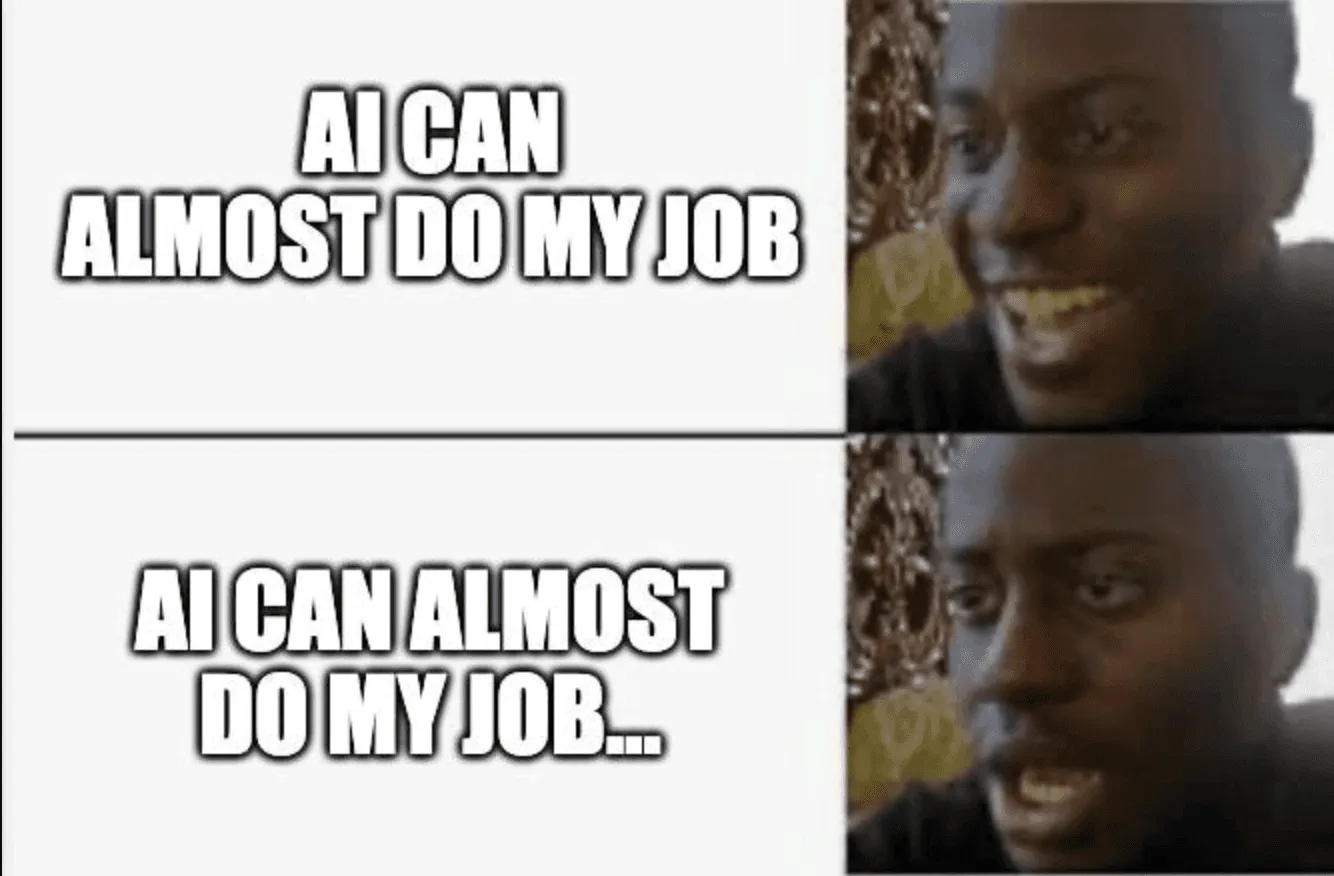
It does not tell us who owns the new companies, who receives the productivity gains, how long retraining takes, or what happens to the people caught between the old economy and the new one.
The economy can grow while individual people become poorer.
Companies can become more productive while employees become less secure.
Both things can be true. Again.
AI Doesn’t Have to Be Perfect to Cause Damage
One of the weakest arguments against AI job displacement is that AI still makes mistakes.
Of course it does.
So do people.
Businesses aren’t comparing AI against a flawless imaginary employee. They compare it with the actual cost, speed, reliability, and availability of human labour.
An AI customer-service system does not need to resolve every ticket correctly. It only needs to handle enough basic requests to reduce the number of people required.
An AI copywriting tool does not need to produce the best advertisement ever written. It only needs to produce something acceptable enough that a company stops paying for ten routine variations.
An AI coding tool does not need to build an entire application independently. It only needs to help a smaller development team complete the same amount of work.
Current AI usage remains well below the technology’s theoretical ability to perform occupational tasks, according to Anthropic’s labour-market research. That should temper the most hysterical predictions of immediate mass unemployment. It should not be mistaken for evidence that nothing is changing.
The technology does not need to replace everybody.
It only needs to change the amount of labour required.

So Why Am I Telling You to Use It?
Because your refusal will not stop it.
You can object to AI on environmental, economic, ethical, artistic, or existential grounds. Some of those objections are extremely reasonable. I hold some of them myself. But guess what?
Your employer will still adopt it.
Your competitors will still adopt it.
Your clients will expect faster results because other providers are using it.
A personal boycott might make you feel good about yourself. It will not meaningfully slow down Microsoft, Google, OpenAI, Anthropic, Meta, or the thousands of companies building on top of their models.
This is where my admittedly bleak “can’t beat them, join them” mentality comes in.
I would prefer that workers had more time, leverage, legal protection, ownership, and input into how this technology is deployed.
That is not the situation most workers have been given.
The choice in front of an individual person is therefore different from the choice in front of society.
Society should ask whether AI is being developed safely, whether its benefits are distributed fairly, whether companies should be allowed to scrape everything ever created, and what happens when labour is no longer required at its current scale.
An individual should ask:
How do I avoid being the easiest part of this workflow to remove?
Those are not contradictory questions.
They operate at different levels.
Refusing to Learn AI Is Unilateral Disarmament
You do not need to become an AI evangelist.
You do not need to call every automation an “agent.”
You definitely do not need to post a photo of yourself staring thoughtfully at a laptop beside the caption, “The future belongs to those who prompt.”
You do need to understand what the technology can do.
More importantly, you need to understand what it can do inside your industry.
The safest position is not necessarily being the world’s best prompt writer. Prompting will become less valuable as models become easier to use.
The safer position is having a combination of:
- Real domain expertise.
- Strong judgment.
- Relationships and trust.
- Responsibility for outcomes.
- The ability to redesign a workflow.
- The ability to use AI without blindly trusting it.
The person who merely produces a routine deliverable is vulnerable.
The person who understands why the deliverable exists, how it affects the business, what could go wrong, and how to improve the entire process is harder to replace.
Not impossible.
Harder.
That is the realistic goal.
Businesses Should Be Honest About What They Are Doing
Companies love to frame AI adoption as “empowering employees.”
Sometimes it is.
Sometimes the company is genuinely removing tedious work, helping employees make better decisions, and creating space for more valuable tasks.
Sometimes “empowerment” means one employee is now expected to do the work of three.
Microsoft’s 2026 workplace research found that organizational factors, including culture, management, and talent practices, accounted for twice the reported AI impact of individual effort alone. In other words, buying AI software is not the same as creating a functional AI-enabled company.
Businesses need to answer uncomfortable questions before automating everything they can find:
Who receives the benefit when a process becomes twice as efficient?
Does the employee get more meaningful work, better pay, or a shorter week?
Or does the company remove a position and increase everyone else’s targets?
Who is accountable when the AI makes a bad decision?
Who checks its work?
Which activities should never be delegated?
What happens to entry-level employees when all the entry-level tasks disappear?
That last question is particularly important.
Companies want senior experts, but senior experts are usually created by spending years doing junior work.
Automate every beginner task and eventually you may discover that you have eliminated your training pipeline.
My Rule: Automate Tasks, Not Accountability
I am not against business automation.
Obviously.
Used properly, automation can remove genuinely miserable work. Nobody dreams of spending Friday afternoon copying customer information between spreadsheets.
But there is a difference between removing pointless administrative friction and removing human responsibility.
My general rule is simple:
Automate repetitive execution. Preserve human accountability.
Use AI to organize information, prepare drafts, identify patterns, route requests, summarize documents, and complete predictable steps.
Be more careful when AI is making irreversible decisions involving someone’s employment, money, healthcare, legal rights, safety, or reputation.
The more serious the consequence, the more meaningful the human oversight needs to be.
Not a rubber stamp.
Not a disclaimer buried in the terms of service.
Actual oversight from someone who understands the decision and remains responsible for it.
What You Should Do Now
First, list the recurring tasks you perform every week.
Do not start with tools. Start with work.
Identify what is repetitive, what requires judgment, what depends on relationships, and what creates measurable value.
Automate the repetitive portions.
Use AI to accelerate the research, preparation, and administrative work surrounding your judgment.
Then use the time you save to move closer to decisions, customers, revenue, strategy, and accountability.
Do not merely become faster at producing the thing AI is rapidly learning to produce.
Become better at deciding what should be produced, why it matters, and whether it is correct.
For business owners, the same principle applies.
Do not begin by asking, “Where can I add AI?”
Ask:
- Where is work getting stuck?
- Where are employees wasting time?
- Where are errors expensive?
- Where does human judgment create real value?
- What happens if the system is wrong?
Then decide whether the solution requires traditional automation, an AI assistant, an autonomous agent, a process change, or absolutely nothing.
Sometimes the best AI strategy is fixing a bad workflow before giving it a robot.
I Hope I’m Wrong
I hope AI creates more opportunity than it destroys.
I hope productivity gains improve ordinary people’s lives instead of flowing almost entirely to shareholders and technology companies.
I hope AI eliminates pointless work without eliminating the income people need to survive.
I hope we build systems that remain under meaningful human control.
But “hope” is not a career strategy.
This technology is here. It is useful. It is improving. Businesses have enormous financial incentives to adopt it, and those incentives are not disappearing because the public conversation feels uncomfortable.
You do not have to worship AI.
You do not have to trust the people building it.
You do not even have to believe the future they are selling.
But you should learn how the technology works, where it is effective, where it fails, and how it will change the economics of your work.
AI may eventually take your job.
Not learning to use it will not save you. You have a choice.
Keep reading
Related posts
Three more worth reading, if this one landed

The AI Model Tier List, October 2026
The best model on this list got cheaper when it got better, and last month's number one fell to C. Nineteen AI models ranked on what they are actually worth, with the blended price and an independent score on every row so you can argue with the placement.

AI Watermarks Are Here. The Danger Is They're Not That Good.
Since August 2, 2026, Claude marks everything it writes. Most of the worry is about being caught. The real problem is that the mark cannot prove what people are about to use it to prove.

How to Get Cited by AI Search. And What a Citation Is Actually Worth.
An AI can cite your website, answer your customer's entire question, and send you absolutely nobody. Getting into the answer matters. What happens after that is the part your dashboard needs to explain.